
A Filipino American Perspective on Romans 12-13
By Frederic Schille
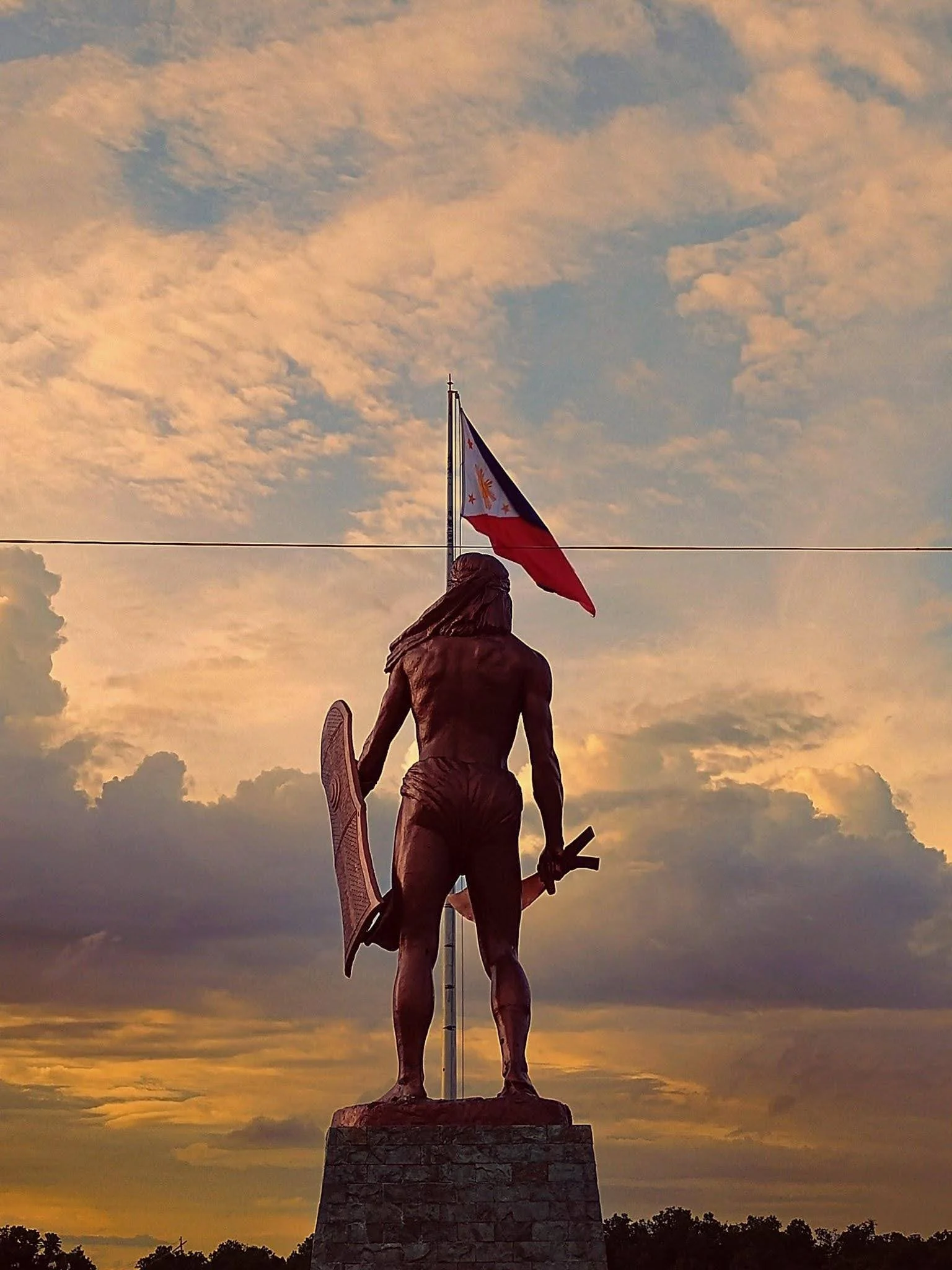
Photo of Lapulapu monument at the site of the Battle of Mactan in Cebu
"C
hristianity is just a tool of empire to pacify the populace into non-resistance.” My tito (uncle) once told me this as he recounted the history of the Philippines to me. To him, it seemed as though imperial powers would conquer, introduce Christianity, and use its tenets to forbid the populace from fighting back. As a Christian pacifist, I had to consider this criticism and wrestle with it. Having studied some of the history myself, it is not difficult for me to understand how he reached that conclusion. That left me with the question, “How does the gospel speak to this situation?”
The missionaries who first brought the gospel to the Philippine archipelago were not peaceful; the story of Christianity’s introduction to the Philippines is mired in the death and bloodshed of pre-colonial Filipino and Spanish lives. In 1521, on his quest to circumnavigate the world, Ferdinand Magellan erected a cross at the site on the island of Cebu where he and his men baptized the family and subjects of Rajah Humabon after a demonstration of Spain's military prowess. In raising the cross, Magellan declared to those who would come after that Spain had claimed these islands, and they were later named Las Islas Filipinas in honor of King Philip II. It was then that Magellan went to war with Lapulapu, one of Humabon’s rivals who had failed to swear fealty to Spain. The explorer did not survive the Battle of Mactan, and Lapulapu was later credited with staving off imperial rule for forty more years. In the wake of that loss, and in response to pillaging done by Magellan’s men, Humabon renounced the faith and poisoned many of the Spaniards. When Spanish forces returned four decades later, they brought with them 300 years of colonialism and the Catholic faith.
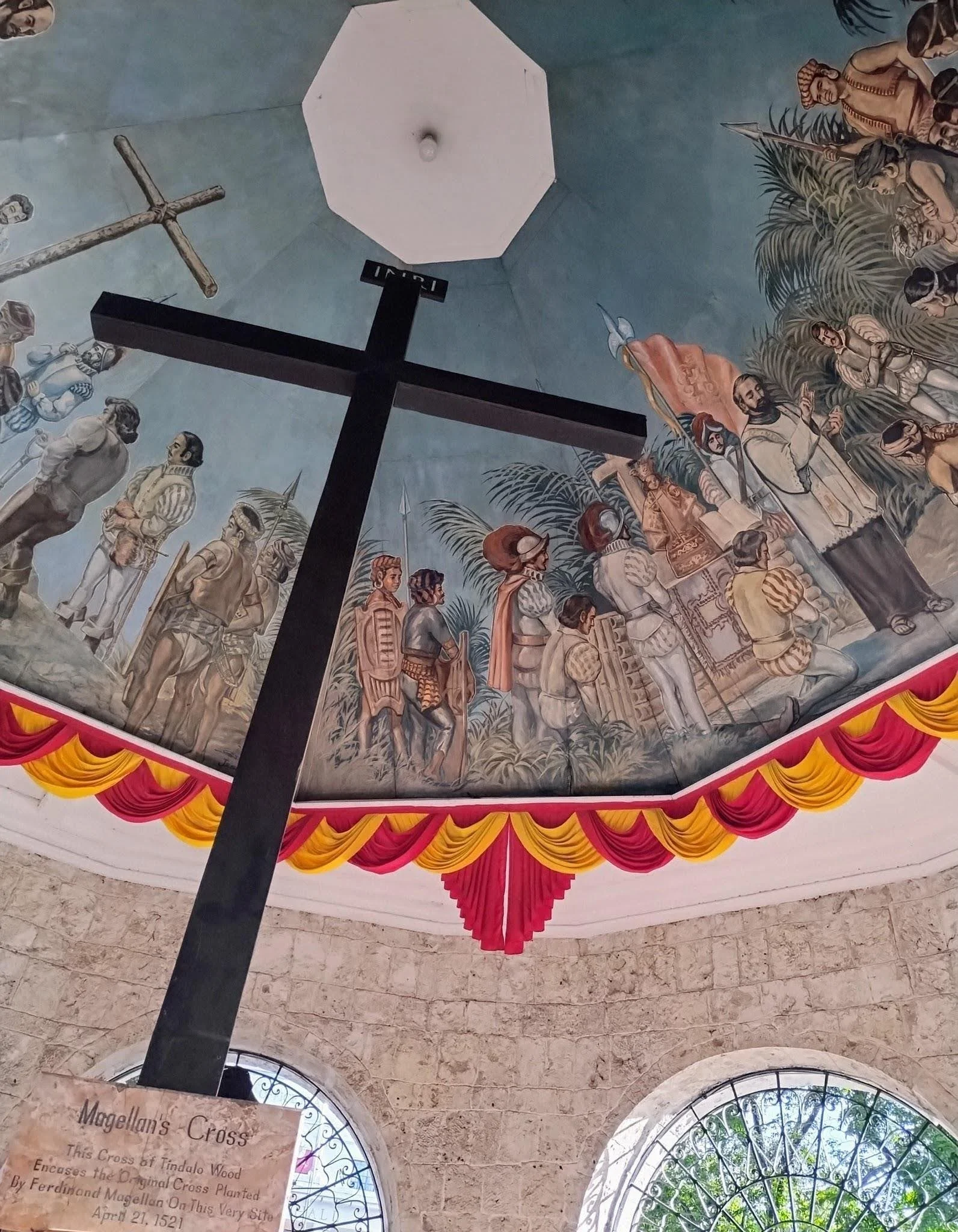
Photo of Magellan’s Cross, protectively encased in tindalo wood, and of mural depicting the baptism of Rajah Humabon
It might be easy to scoff at this as a Protestant, but we have a sordid history in the Philippines as well. During the Spanish-American War (1898), The US sent ships to fight Spain in the archipelago. For their part, the Filipinos were already fighting a revolutionary war against their colonizers and had the Spanish forces surrounded in Manila. Even though the Philippines declared its independence, America refused to recognize it, and Spain found it more acceptable to surrender to white men rather than the indios (See “The Mock Battle that Ended the Spanish-American War,” by Theodore S. Gonzalves). With the Spanish ceding control of the Philippines to America, President William McKinley (1843–1901), a devout Methodist, was faced with a grave dilemma: what was to be done with the islands? As he recounts it, he wandered the halls of the White House nightly, praying to God for wisdom in what to do with this new possession. The answer to this prayer? That America should take dominance over the Philippines that they might be Christianized, never mind the fact that the nation was essentially the only Christian nation in Asia at the time (See Christian History and Biography, Issue 99, “A Nation on Mission”). I personally only learned of this religious shape to the American colonization of my mother’s land during my second year of seminary. When I complained about this to white classmates of mine, the response was shocking. “Would your family have been Christians if not for colonization?” they asked.
I have carried these two perspectives, those of my tito and my classmates, with me for many years, trying to discern the right way to respond. The painful reality has been that biblical passages such as Rom. 13:1–7 have been used to justify the horrors of colonialism; by right of conquest, the imperial powers were granted the divine right to rule. When the government has the power of the sword, it becomes a common conception that the blood they spill is justified, particularly if it was done for the advancement of Christianity. It has become such that any criticism of this colonial ideal, even in retrospect, becomes taboo. For many Filipinos, this ends up taking the form of colonial mentality—the internalization of the colonizing power’s superiority and the subject’s inferiority. For some Filipinos, this can look like bleaching the skin in an attempt to look white. For others, it is wanting to do everything like the Americans. In my own youth, this meant looking upon my more Filipino features as ugly and my own cultural staples as weird. One extreme example was when I was told by a Filipino immigrant that she did not like talking about the Pacification of Samar, a genocidal act undertaken by the US during the Philippine-American War on the very island from which she was from, because it made the US look bad. All of this ultimately stems from a very poor reading of the text.
While it is not entirely certain under which Roman emperor this epistle was delivered, it was nevertheless written at a time when Rome was hostile toward Christianity. This should automatically negate the understanding that every use of the sword by the government is justified. Rather than a baptism of governmental authority, we see the authorities being called to bend their knee to the King of kings. “There is no authority except from God,” Rom. 13:1 (ESV) states, “and those that exist have been instituted by God.” Also, “he is God’s servant…he is the servant of God,” in Rom. 13:4 is a radical demotion of an emperor who claimed actual divinity rather than the elevation of such authority as is commonly perceived today. As Bonhoeffer observed in Discipleship, "No authority can legitimately interpret Paul's words as a divine justification of its existence. If by chance there actually was a case in which this statement would be heard by an authority, then it would also become a call to repentance for that authority, just as in this context it is in truth a call to repentance for the church-community. Those in authority could never interpret it as a divine authorization of their conduct in office.” What then is to be done with respect to action then? I would contend that Rom. 13:1–7 should only ever be read in light of Rom. 12:14–21.
Beginning with verse 14, Paul encourages believers to identify with the lowly and mournful, and also to live peacefully with all, even with those that persecute them, going so far as to bless them. Avenging oneself is forbidden, but why? Does this not just lead to submitting ourselves to violent subjugation? That would only be the case if we did not believe in the resurrection of the dead and life everlasting. This is entirely because the hope of the Christian is founded upon the promise of Christ’s return; “Leave it to the wrath of God, for it is written, ‘Vengeance is mine, I will repay, says the Lord,’” (Rom. 12:19). We believe that Christ will return and make all things new, that he will judge the wicked and set everything right once more. The evils committed against us will not go unpunished. Furthermore, because I too was once an enemy of God, but have been reconciled to him, I can look at those who are my enemy with the same love that Christ demonstrated towards me. When my enemy is hungry, I can feed him; if he is thirsty, I can give him something to drink. I do not have to be overcome by evil, because I know that evil will be overcome by good.
On a recent trip to the Philippines, I visited many historical sites and churches, all while wrestling with the ideas of colonialism and pacifism. I saw the site where Christianity was introduced to the Philippines, and the site of the Battle of Mactan where Magellan was slain. I wrestled with the complicated history the US has in the Philippines as I visited MacArthur’s landing, the site where the US Army general fulfilled his promise to return and liberate the islands from Japanese rule during World War II. But the sight which impacted me the most was the icon I saw at a church we visited for the funeral of a family friend. Rather than the expected image of Christ crucified, I saw Christ, risen in glory and in the communion of the saints. Beneath him were two angels, adorned in traditional Filipino tribal tattoos. These figures were redeemed, not through the forsaking of their Filipino identity and the adoption of colonial mentality, but as wholly Filipino. Despite the efforts of the colonial powers, the gospel was still proclaimed throughout the Philippines. As we look back upon history, we can condemn the evil actions of our oppressors, and give praise to our God who works all things together for those who love him and are called according to his purpose.
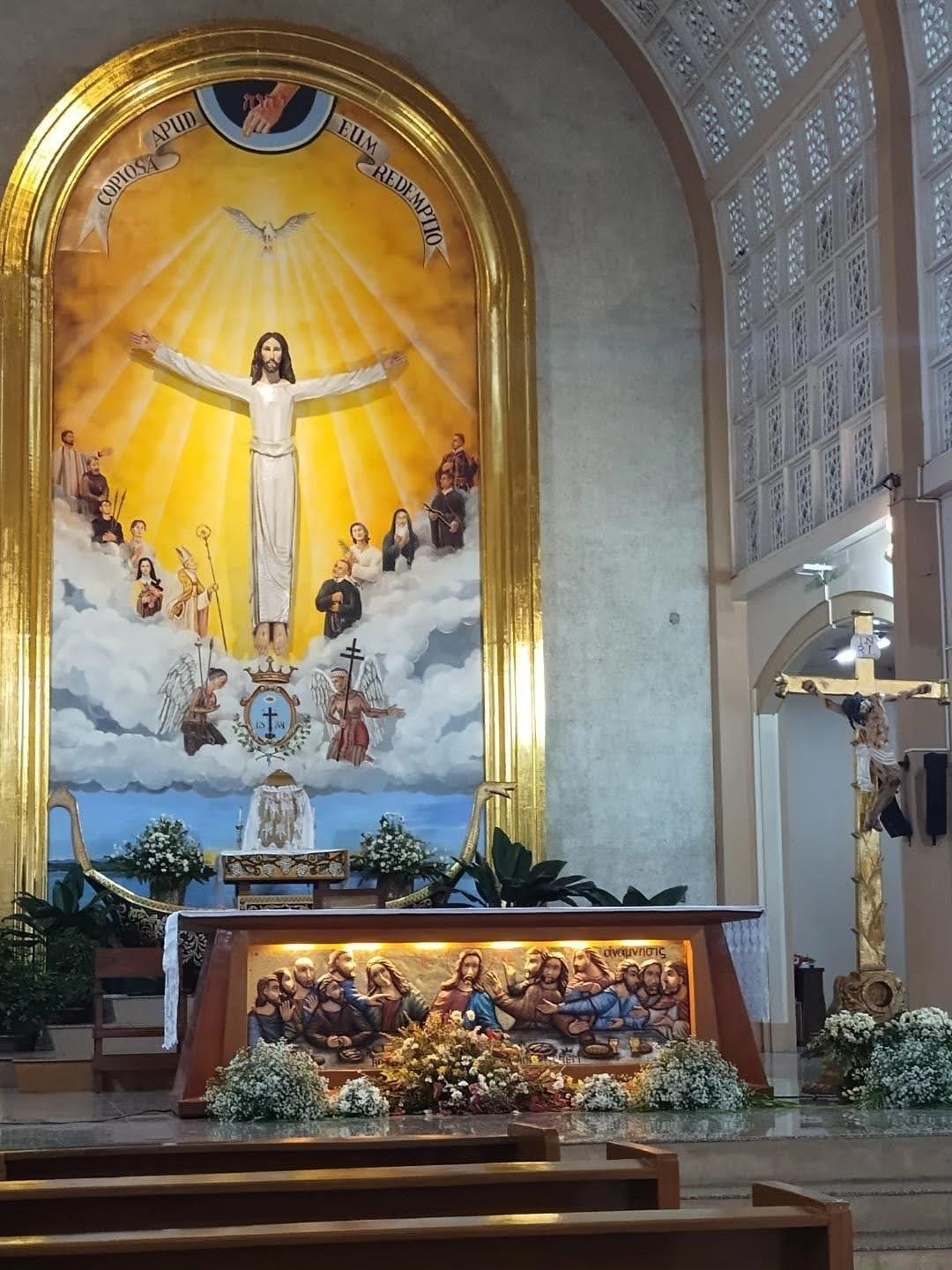
Photo of the icon at Our Mother of Perpetual Help in Tacloban City
Photo credits: Frederic Schille

Fredric Schille is a second generation Filipino American immigrant from Wauwatosa, WI with Visayan and German ancestors. Presently an MDiv student at Gordon-Conwell Theological Seminary, his academic interests include political theology, eco-theology, theology of sexuality, and Christology - a reflection of his firm conviction that Christ transforms every aspect of reality. He holds a B.A from Moody Bible Institute.
More Like This:

Help us continue the work of empowering voices. Give today.