
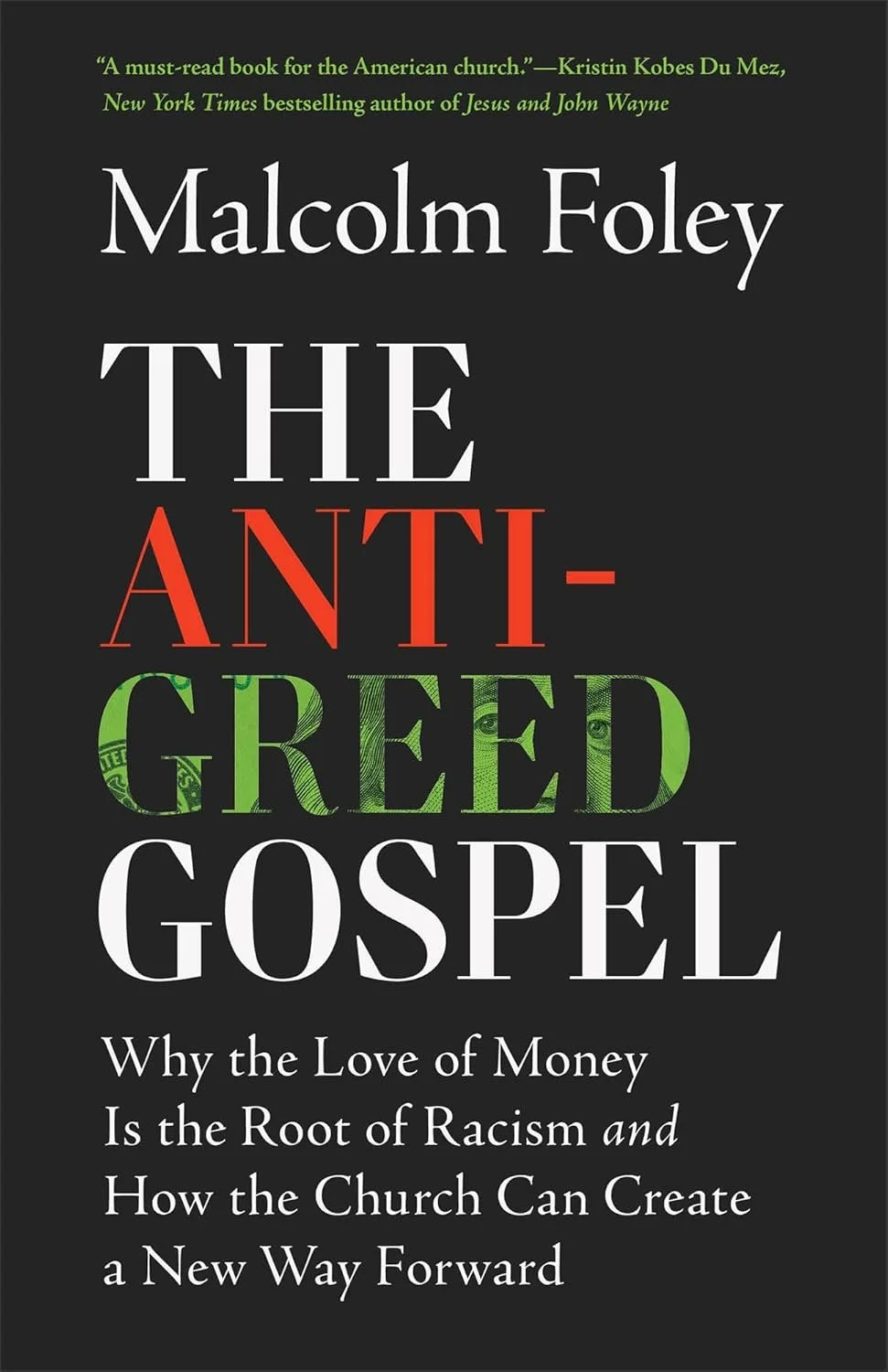
Book Review: The Anti-Greed Gospel
By Daniel Harris
I
remember reading Jonathan Tran’s book Asian Americans and the Spirit of Racial Capitalism for the first time when it came out in 2022. This book was the first book to introduce the concept of racial capitalism to me. As a result, Tran single-handedly upended the way I think about race. Much of what I had heard about anti-racism was that the best way to combat racism was to embrace one’s racial identity in order to resist racism. I had believed that racism is mostly a psychological and pathological disease that can be eradicated through education and DEI programs.
What Tran’s book revealed is that this way of thinking about race is historically inaccurate. This view also further fuels racism by justifying it by saying that one’s race is “essential” in some way to one’s identity.
So what then? Should we just concede to color blindness? This is where racial capitalism becomes a useful tool in understanding racism. Racial capitalism says that racism isn’t primarily a psychological or pathological disease; instead, it’s an economic disease.
The biggest issue I had with Tran’s book is that it’s a very dense and academic book that might be out of reach for a broader audience. This contrasts with Malcolm Foley’s latest book The Anti-Greed Gospel: Why the Love of Money Is the Root of Racism and How the Church Can Create a New Way Forward. If you or your church is wanting an introduction into understanding racism and some practical tools on how to combat it, this is the book to get.
Foley’s book, in many ways, was inspired by Tran, making liberal use of Tran quoting him often. This isn’t a bad thing, since Foley’s book is making concepts of racial capitalism more palatable to a broader audience. This doesn’t mean that he is just regurgitating Tran. Foley provides his own useful research, particularly surrounding lynching, that helps guide people in understanding how racial capitalism makes racism possible.
Foley states his main idea in the introduction:
Race is not primarily about hate and ignorance. It’s about greed. It always has been. And the purpose of this book is that you might understand the unholy relationship between race and greed, best understood not as a marriage but in terms of parentage: race and racism are children of Mammon.
For Foley, in order for us to speak coherently about race, we need to understand that the church is engaged in a cosmic battle against powers and principalities: “The stakes are cosmic: we are engaged in a battle of gods, and this book is precipitated by the fact that rival gods require blood sacrifice. Mammon is no different.”
Book Structure
Foley’s book has two major sections. The first section is titled “Our History of Greed, Race, and Racial Capitalism,” and the second section is titled “Where Do We Go from Here?” As the titles suggest, the first section defines racial capitalism and looks at the historical underpinnings of race, and the second section gives practical advice on how the church should respond.
Racial Capitalism and Lynching
In the first section, Foley outlines what he means by racial capitalism. Foley says that our modern form of capitalism is primarily fueled by self-interest. Moreover, our modern form of capitalism is “neoliberal” capitalism that has enshrined individual fulfillment as its ultimate end. In short, capitalism justifies greed by fueling our individual self-interest that maligns our love of neighbor.
What does this have to do with race? Foley argues that the greed that is fueled by capitalism is used to justify racism: “An economy built on slavery became an economy built on race and, in the grand scheme, an economy built on greed and violence.”
Here, Foley makes an interesting turn in the book. Foley flexes his muscles as a historian, discussing how racial capitalism and greed were used to justify lynching. Of particular note, Foley uses three figures to discuss different responses to lynching: Francis Grimke, Atticus Haygood, and Ida B. Wells.
Grimke and Haygood are used as negative examples of how to respond to racism. Grimke saw racism primarily as an issue of hate rather than greed. Thus, the response Grimke proposed was to promote education and awareness. Foley expertly shows how Grimke’s response ultimately led him to justify violence. Haygood, on the other hand, was a white pastor whose response to racism was paternalism. Paternalism reduces Black Americans to children rather than neighbors. Paternalism ultimately would justify lynching.
Finally, Foley points to Ida B. Wells as a positive response. Wells was born a slave and became an activist when she became editor-in-chief of the Memphis Free Speech and Headlight. Unlike Grimke and Haygood, Wells could see the economic underpinnings of lynching. Wells’ response to racism was economic in nature: Black Americans should leave their lynching communities in order to cripple them economically. Foley uses Wells as a constructive response to racism.
Response to Racism
Foley’s response to racism is threefold: economic solidarity, creative anti-violence, and prophetic truth-telling.
Economic Solidarity – If racism is about greed, our response needs to be economic in nature. Foley uses the incarnation as an example of the self-giving philanthropy required to defang racism. In the same way that Christ emptied himself on the cross, the church is called to find economic solidarity with their neighbors.
Creative Anti-violence – For Foley, anti-violence is not a passive response to racism. Instead, anti-violence is an active response to the culture of death that racism promotes. This logic is built on Christ, who gives us a new way of living pictured in the Sermon on the Mount. Living out Christ’s kingdom means being against that which promotes death.
Truth-telling – For Foley, in order to combat the lies racism tells, we need to commit ourselves to truth-telling; this entails speaking truthfully about the economic reality of racism. The church stands in the prophetic tradition of the Old Testament prophets who spoke truth to power, calling out greed and idolatry.
Is Foley a Marxist?
All of this talk of capitalism might leave some cautious. Many reading this review might have families who have come from oppressive Communist regimes; this is true of my own family. I understand the caution. However, to ease everyone’s fears, Foley himself is not trying to promote a particular economic system.
Foley writes, “The revolution that we bear witness to is the revolution of the cross, the very thing that the Lord has used to shame the powers and principalities. That is the weapon of our warfare.”
In other words, whereas Marxists wait around for a revolution to come where the proletariat will seize the means of production, we Christians believe the revolution has already come. Moreover, the weapons we use are ones of anti-violence and self-giving, which are antithetical to Marxist theory. Moreover, much of the book is grounded in Scripture and supported by the tradition of the church. Greed and Mammon are mentioned in Scripture from the very beginning, and the tradition undergirds Scripture’s witness.
Foley’s prescriptions in the second section are also prescriptions that are particular to the church. This book is not a list of government policies or suggestions on particular laws that should be enforced. I personally think that this works in the book’s favor. For many Christians, our political imaginations have been dulled to think that the only way we can get things done is through the coercive means of the government. Foley shows us another way.
Conclusion
Foley’s book The Anti-Greed Gospel is an excellent introduction to racial capitalism as a constructive way to think about and defang racism. The constructive responses Foley outlines in this book are radical, but the gospel of Jesus Christ is radical.
This book can be difficult to read, not in an academic sense, but because the subject matter is heavy. Particularly when Foley narrates the history of lynching, I had to put the book down for a while to process what I had just read. However, truth-telling requires that we uncover even the dark parts of our histories.
I recommend this book particularly for Asian Americans who are interested in the conversation surrounding race and racial capitalism and are looking for practical ways to combat racism. While this book does not center the Asian American experience, I think racial capitalism is a useful way of understanding the racial experience of Asian Americans as well. For example, the myth of the model minority starts to make more sense when people start looking at its economic underpinnings. For more on that, you can read Jonathan Tran’s book.
For anyone looking for a constructive response to racism that is approachable for a wider audience, this is the book to get. I hope and pray that the church will read this important book and implement economic solidarity, creative anti-violence, and truth-telling in their congregations.

Daniel Harris is of mixed Cambodian American heritage. He currently serves as campus minister of Charis Student Ministry, a collegiate ministry through American Baptist Churches of Indiana/Kentucky. He also serves as Content Writer for AACC. Daniel has his M.Div. from Baylor’s George W. Truett Theological Seminary in World Christianity and Christian Witness and his B.A. from Howard Payne University. He enjoys spending his time with his wife and three beautiful daughters.
More Like This:


Help us continue the work of empowering voices. Give today.