
Genocide Awareness Month: living nonviolently in a violent world
By Daniel Harris
A
pril 17, 1975, was a fateful day for my family in Phnom Penh, Cambodia. This was the day that Pol Pot led the Khmer Rouge army to overthrow the capital city. On this day, my family was forced out of their home.
My family, along with millions of others, were funneled into forced labor camps in the countryside. Pol Pot had envisioned that Cambodia would become an agrarian utopia where class distinctions would cease to exist. Like most utopian dreams, the reality was more like a dystopian nightmare.
My mother has told me numerous stories about their time in the labor camp. They were forced into reeducation and working in the rice fields. The goal was to eliminate all class distinctions. Anyone who had an education, lived in the city, or worked a white-collar job would be forced into the camps.
A by-product of this was that Cambodia was left with no doctors or nurses who could help when people were sick. My mother once told me a story about a time when she fell ill and had to see a “doctor.” This “doctor” was a 12-year-old boy who stuck an unsanitized syringe filled with coconut water into her arm. It nearly killed her.
The forced labor in the rice fields led to a genocide in Cambodia which has been dubbed the “Killing Fields of Cambodia.” To this day, acres of farmland are rendered unusable due to buried mines that are scattered across the land. The estimated death toll is between 1.5 million to 3 million lives.
My mother often credits their survival to my grandfather. A real-life MacGyver, my grandfather was gifted at fixing things and creating useful tools out of spare parts and junk. He created things like shoes and lighters, and even made rice wine for the Khmer Rouge soldiers. He was also a gifted linguist who was fluent in at least five languages; and from what my mother tells me, this was largely self-taught. I remember sitting around with my cousins at his funeral trying to parse out what was fact and what was legend. Regardless, one can see why they would have wanted to keep him around.
Even during the Khmer Rouge, hope seems to still find a way. However, not every family had someone like my grandfather. My family was lucky. All of my mother’s eight siblings survived the aftermath of the Killing Fields. Not everyone was as lucky as they were.
The summer after my senior year of college, I had the opportunity to take a tour of Auschwitz. The night before, we had a meeting to discuss the plans for the tour and what the day would look like. Hands shaking with sweat rolling down my forehead, I said to the group, “I could use prayer. I don’t know if I can confront the demons my family faced in Cambodia.”
Our tour was mostly about the Romani victims of the Holocaust. Nazi Germany systematically persecuted the European Roma, in addition to the European Jews and other people groups. Our Romani tour guide led us through where the atrocities took place. One area that nearly broke me was a chamber with a glass wall that displayed all of the hair that had been removed from people before they entered the gas chambers. There, I saw the family members I would never be able to meet. I was confronted with their stories, their pain.
Outside, our tour guide pointed toward the living quarters of the Gestapo. One of the things I found fascinating about the tour is that our tour guide went through great pains to try and humanize the perpetrators. “That is where they sent their kids to school,” he said, pointing towards a small building across the street. “These people were not monsters; they were humans.”
The thing I find the most terrifying about my family’s experience in Cambodia is that the Khmer Rouge were not monsters; they were human beings. As Christians, Genocide Awareness Month is important because we recognize that each of us can commit atrocities such as these.
The Nobel Prize-winning author Aleksandr Solzhenitsyn wrote a seven-part account of his experience being imprisoned in Soviet Russia titled The Gulag Archipelago 1918–56. In Part I titled “Drunk Driving, Scapegoats, and Gulag Wisdom,”he described the line between good and evil: “Gradually it was disclosed to me that the line separating good and evil passes not through states, nor between classes, nor between political parties either – but right through every human heart – and through all human hearts. This line shifts. Inside us, it oscillates with the years. And even within the hearts overwhelmed with evil, one small bridgehead of good is retained. And even in the best of all hearts, there remains…an un-uprooted small corner of evil.”
For thousands of years, Christians have confessed that we live in a sinful world. Not only that, but as Solzhenitsyn argues, the line of evil flows through every one of us. If we are not careful, if we do not keep vigilant watch, we can easily be overtaken by that evil.
In 2019, Brandt Jean demonstrated a daring act of forgiveness in front of national audiences. Brandt Jean’s brother, Botham Jean had been murdered by Amber Guyger, a police officer, seemingly due to the color of his skin. At Guyger’s sentencing, Brandt Jean told Guyger that he forgave her and embraced her. I was in seminary at the time, and I remember conversations swirling around the relationship between forgiveness and justice. Many thought Brandt Jean’s forgiveness happened too quickly; they thought that justice should have taken place before he let Guyger off the hook.
These arguments are legitimate. There are times when forgiveness can be thin and lacking in substance. However, I’m not sure it is my or anyone else’s place to tell someone when and how to forgive someone, especially in situations like Brandt Jean’s.
Forgiveness plays a crucial role in the life of a Christ-follower. We often say we forgive because Christ has first forgiven us. Perhaps Brandt Jean knew this better than we do. Crucially, forgiveness is an act of resistance. By forgiving, we resist the temptation to treat the ones who have wronged us in the same manner that they have treated us.
I believe this is what happened on the cross when, in Luke’s Gospel, Jesus says, “Father, forgive them, for they do not know what they are doing” (Luke 23:33, NIV). At this moment, Christ is resisting the temptation to become like those who are crucifying him. He hands himself over to them to resist becoming like them.
I like to think that maybe Brandt Jean had to forgive Guyger to resist the temptation of becoming like the murderer he was confronting. In this way, forgiveness often begets justice rather than the other way around, as we typically think.
I’ve often wrestled with this given my family’s experience in Cambodia. I’m not in the position to tell anyone when and how they need to forgive the people who may have wronged them. However, since we are all cut from the same cloth, and because the temptation of evil is ever present and resides in all of us, maybe forgiveness is the best way forward.
Genocide Awareness Month reminds me of the need for forgiveness. It reminds me that to resist evil, we need to forgive those who have wronged us. This is only possible through the Holy Spirit. The Holy Spirit is the one who forms the church into a forgiving people. In doing so, we become a nonviolent people who can exist in a violent world.
My mother’s body is like a walking memory of the atrocities carried out by the Khmer Rouge. She still has burn marks where they would put out lit cigarettes on her body. When I imagine the resurrected Jesus, I like to imagine that Christ bears those scars for her. He wears them for her. It is this same Jesus who bears my mother’s scars and can also bear the weight of our pain and suffering and make forgiveness possible. It is this Jesus who makes it possible for us to live nonviolently in a violent world.
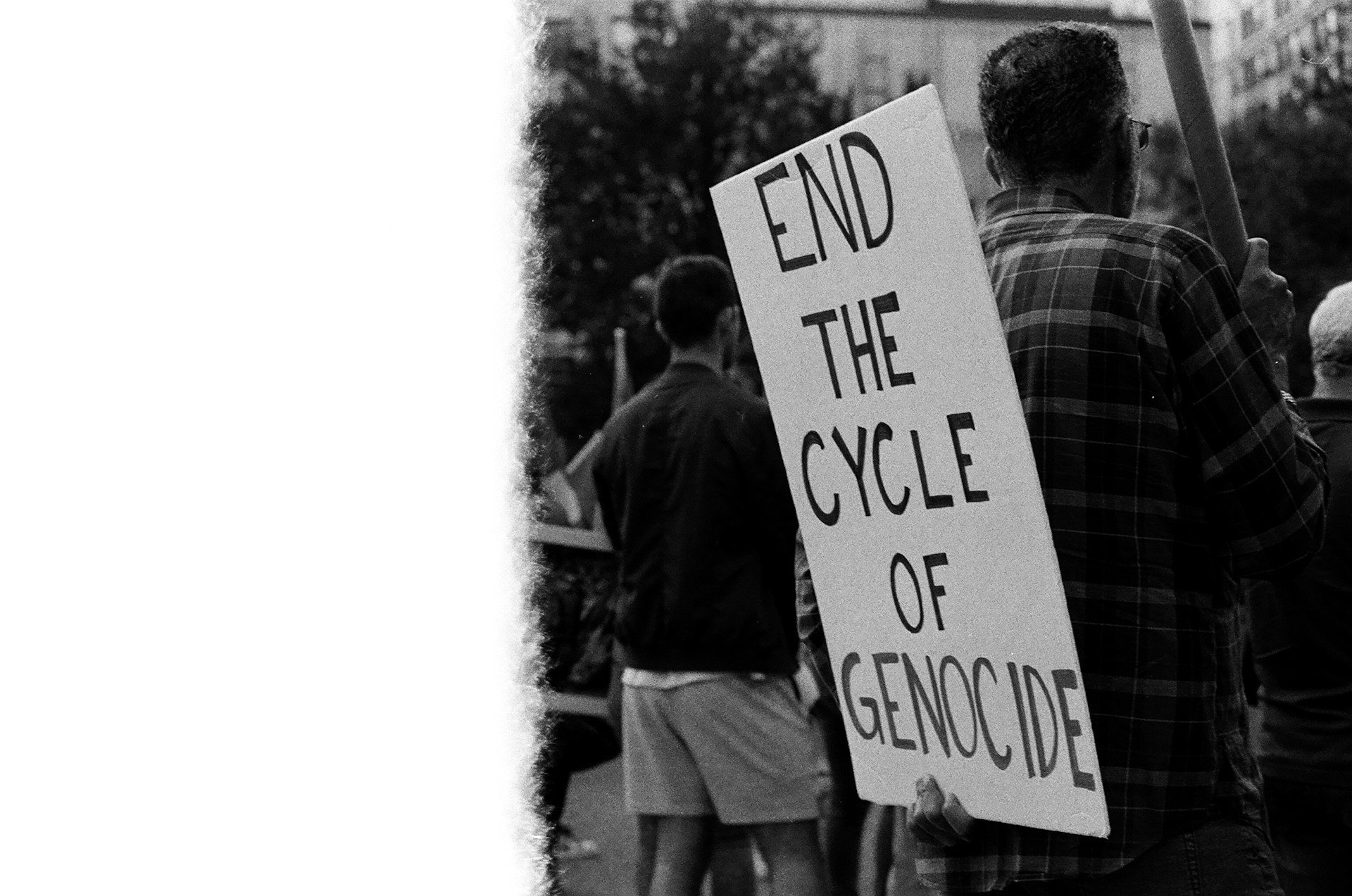
Photo by John Money on Unsplash

Daniel Harris is of mixed Cambodian American heritage. He currently serves as campus minister of Charis Student Ministry, a collegiate ministry through American Baptist Churches of Indiana/Kentucky. He also serves as Content Writer for AACC. Daniel has his M.Div. from Baylor’s George W. Truett Theological Seminary in World Christianity and Christian Witness and his B.A. from Howard Payne University. He enjoys spending his time with his wife and three beautiful daughters.
More Like This:

Help us continue the work of empowering voices. Give today.